As app and game marketing becomes increasingly competitive, video creatives are no longer a “nice to have” — they are the core driver of performance. With the rise of AI video generation tools, advertisers now have more options than ever to produce promotional videos at scale.
However, not all AI video tools are built for advertising, and even fewer are truly optimized for app and game promotion. In this article, we compare the most common AI video generation approaches on the market, focusing on URL-to-video capabilities, model logic, and their limitations in real-world ad campaigns.
The Traditional AI Video Generation Approach
Most existing AI video tools follow a similar logic:
- Extract screenshots, scenes, or text descriptions
- Automatically stitch assets together
- Apply predefined templates, transitions, and background music
In this setup, AI essentially acts as an automated video editing assistant. While this improves production efficiency, it does not mean the AI understands the app or game itself.
As a result:
- The generated videos often lack clear advertising hooks
- Creative logic is shallow or repetitive
- The focus is on visual assembly rather than conversion performance
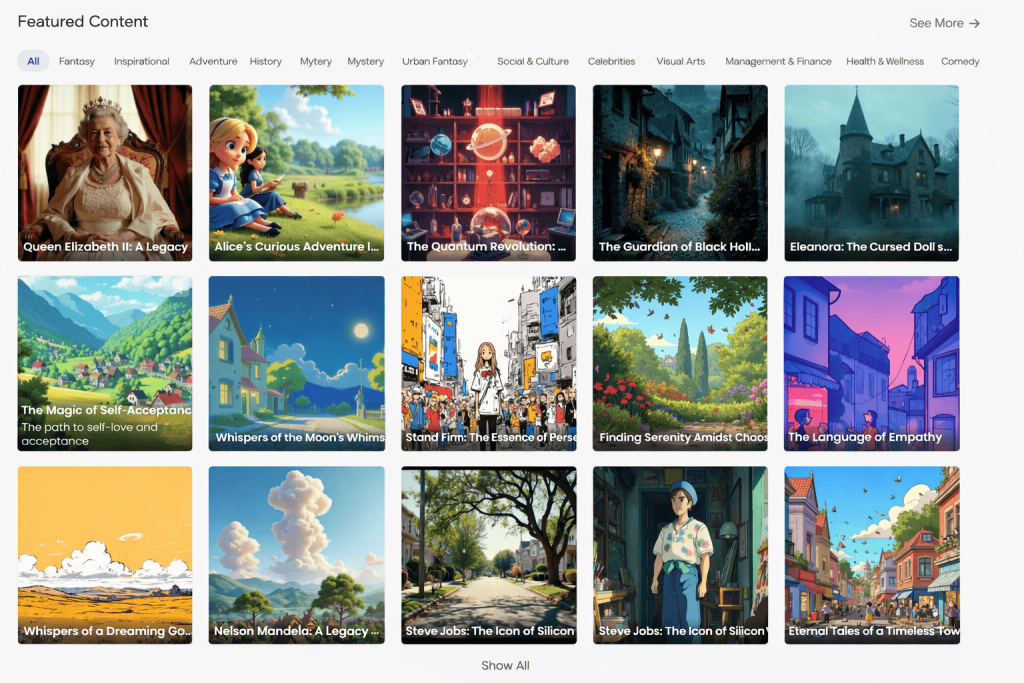
More importantly, many tools are built around the idea of generating one complete video, rather than supporting the realities of modern performance marketing.
Why “One Video” Is Not Enough for App Advertising
In real-world advertising, success depends on:
- Multiple creative variants
- High-frequency testing
- Rapid iteration and elimination
A single polished video cannot meet these requirements:
Most traditional AI video tools evaluate success based on how “good-looking” the output is. They emphasize clean visuals and smooth transitions while ignoring the most critical factor in short-form advertising: the first three seconds.
Without a strong opening hook, users scroll away before the message is delivered. Fixed templates and repeated structures also lead to high creative similarity, making videos easy targets for platform duplicate-content detection.
Two Advertising Eras: What Changed?
Early Stage: Low Creative Pressure
In the early days of mobile advertising, platform algorithms were relatively simple. Even with limited creative diversity, ads could still perform well. Repetitive content was tolerated, and creative fatigue built up slowly.
Today: High Frequency, High Sensitivity
Today’s environment is very different. AI tools are widely used, and creative production has scaled dramatically. As a result:
- Creative homogenization is widespread
- Ad fatigue occurs much faster
- Platforms demand stronger early engagement signals
Modern algorithms prioritize retention, CTR, and creative diversity. Traditional AI video generators struggle to support high-frequency, performance-driven campaigns.
Why Hooks Decide Whether an Ad Survives
In today’s short-form ecosystem — dominated by TikTok, Instagram Reels, and YouTube Shorts — the hook determines everything.
The first 1–3 seconds directly impact:
- Initial retention
- Early CTR
- Whether the platform continues distributing the ad
If the hook fails, the ad never scales — regardless of how polished the visuals are.
This is why generating multiple hooks is more important than generating one “perfect” video.
Comparing AI Video Tools for Promotion
Most AI-powered video generation tools for marketing purposes are more geared towards e-commerce products. They can extract product images and page descriptions from e-commerce product links to integrate video, or automatically generate complete videos based on text/script descriptions and source materials.
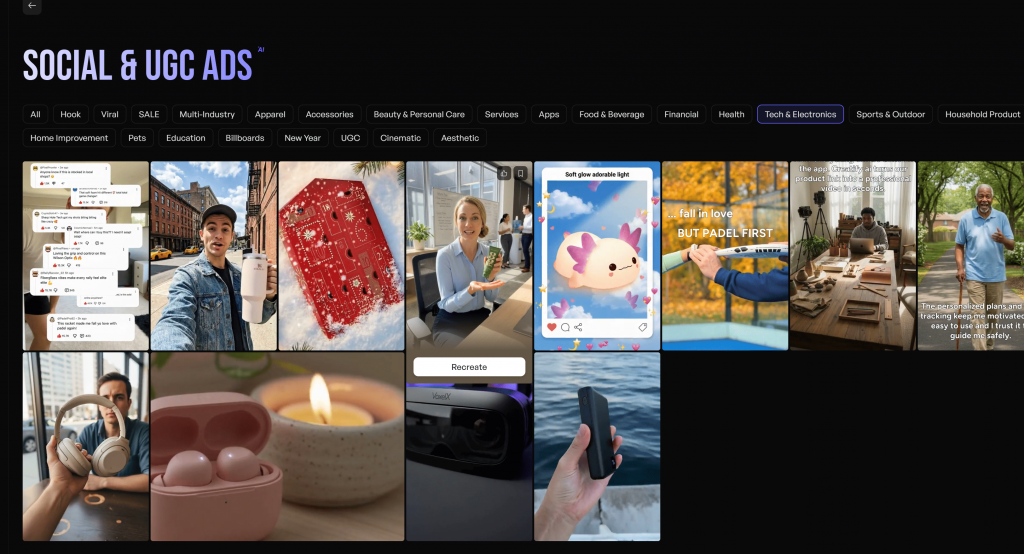
1.General URL-to-Video Tools(Taking Creatify as an example)
These ai video creation platforms convert web pages or text content into videos by summarizing and visualizing information.
Strengths
- Fast content-to-video conversion
- Flexible for blogs and brand content
Limitations
- Not optimized for app or game promotion
- Limited understanding of UI, gameplay, or feature hierarchies
- Weak alignment with performance marketing needs
2.Prompt-Based Generative Models(Taking Heygen as an example)
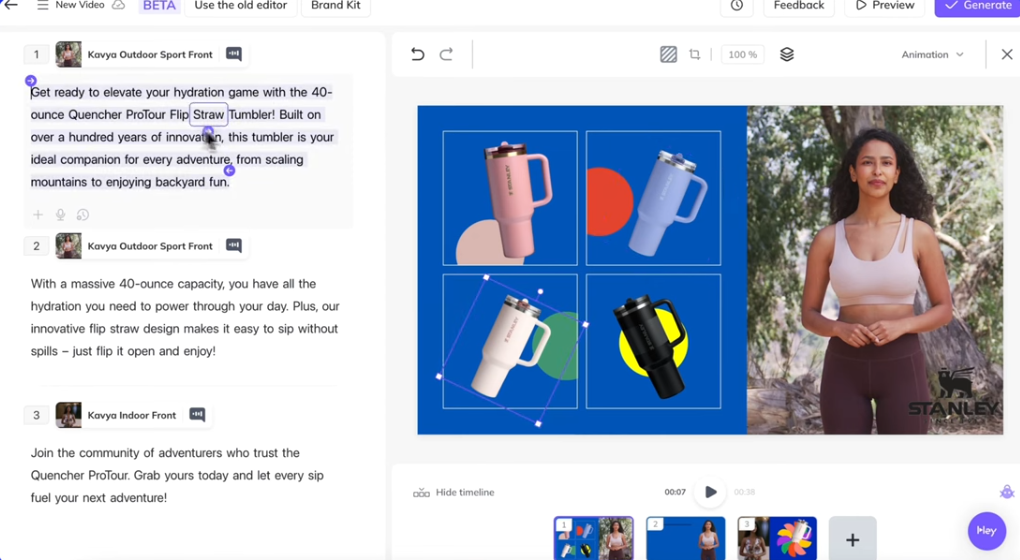
Text-to-video models generate videos purely from prompts.
Strengths
- High creative freedom
- Visually impressive outputs
Limitations
- Cannot automatically parse Google Play URLs
- Require manual scripting and prompting
- Not designed for scalable ad production
- Weak connection to real product features
- Leaning towards verbal delivery.
- More like AI video editing tools
The Core Limitation Across Most Tools
Across categories, most AI video tools share the same structural limitation:
They optimize for video creation, not advertising performance.
They do not:
- Understand advertising hooks
- Generate large-scale hook variations
- Adapt to platform-specific performance signals
As a result, they struggle to support:
- High-frequency campaigns
- Creative testing at scale
- Long-term CPI optimizationLong-term CPI optimization
In short, existing video tools tend to focus on video synthesis based on material descriptions or emphasize character avatars and voice synthesis.
A Hook-First Approach to AI Video Advertising
Modern app and game advertising requires a different mindset.
Instead of asking:
“How do we generate a good-looking video?”
The real question is:
“How do we generate enough hook variations to find what actually converts?”
With a hook-first AI approach, a single app or game can generate dozens of video variants, each with a unique opening scenario. These hooks can be tested rapidly to identify which creatives are able to scale.
Using our AI tool, you can:
- Input a Google Play URL
- Wait a few minutes
- Automatically receive multiple promotional videos with different hook openings
Uploading screenshots or gameplay footage is optional — not required.
Conclusion: The Future of AI Video Ads
Traditional AI video tools helped reduce production costs. But in today’s advertising landscape, efficiency alone is no longer enough.
The future belongs to AI systems that:
- Understand advertising logic
- Generate creative diversity at scale
- Focus on hooks, testing, and performance — not just visuals
If you are struggling with creative fatigue, limited scalability, or declining ad performance, it may be time to rethink how your AI video tools work.
Try a hook-first approach — and let performance, not templates, decide what scales.